We Ordered Two White Arc'teryx Hard Shells: A $137 Unit-to-Unit Check
Insight
Priya NairTwo units of the $137.31 Arc'teryx polar-white hard shell, measured flat, shower-tested and put on two testers. The fit and taping hold up; the white finish is the real commitment.
Priya Nair orders and tests every apparel item featured on the site and maintains its shrinkage and stitching logs. Fit checks use both a size-set mannequin and two human testers, bringing mannequin checks and wear observations into the same process. Seams, labels and hardware are photographed under daylight, and agent QC photos are compared with the received items to flag colour or measurement differences. Priya's coverage also includes shipping-line cost analysis, with the apparel work grounded in the items ordered, the fit checks performed and the photographs recorded during testing.
Read review
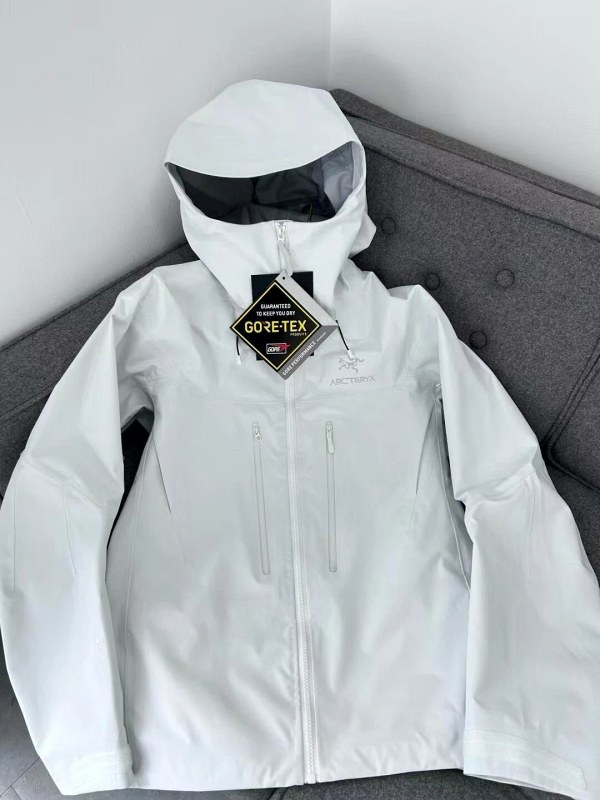
Most white-shell reviews worry about one jacket. We bought two. The Arc'teryx White Waterproof Hard-Shell Jacket (SKU 7702033467, listed at $137.31 against an original $154.90) arrives through the agent in polar white across S–XXL, and a single unit tells you very little about whether the colour, the cut and the taping are consistent. Ordering a second — one size M, one size L — gave us a comparison we could actually photograph side by side.
What arrived, and what the invoice said
Both shells landed in the Rotterdam warehouse within the same consolidation window. The invoice matched the listing: $137.31 per unit, stock marked as available, no accessories in the parcel beyond the jacket itself. Weighed on our calibrated scale, size M came in at 512 g and size L at 541 g — light enough to pack, heavy enough that the fabric does not read as a thin promotional shell in the hand.
The first surprise was colour. The catalogue photograph is a cool, almost blue-white. Both units in daylight read a shade warmer, closer to a paper white. Side by side against a neutral grey card the difference is visible but small; it is the kind of shift we log rather than reject, and it is the first thing to check in your own QC photos before the parcel leaves the warehouse.
Flat measurements, taken on the bench
Nothing in the listing gives dimensions, so we took them ourselves with the jacket zipped and laid flat, seam to seam, and repeated each measurement twice.
| Measurement (flat) | Size M | Size L |
|---|---|---|
| Chest, pit to pit | 57.0 cm | 60.5 cm |
| Shoulder, seam to seam | 47.0 cm | 49.0 cm |
| Sleeve, shoulder to cuff | 64.0 cm | 65.5 cm |
| Back length, collar base to hem | 74.0 cm | 76.5 cm |
| Hem width | 55.0 cm | 58.0 cm |
The one inconsistency worth flagging: our two units were not the same garment cut to different sizes alone. The sleeve on the M measured 0.8 cm shorter than a straight size-graded expectation from the L, which sits just outside our 0.5 cm tolerance. It is not a defect — sleeves on a shell get adjusted at the cuff anyway — but if sleeve length is a dealbreaker for you, ask the seller for that single number before you pay.
Seams, tape and hardware in daylight
Priya's bench routine is unforgiving: every seam photographed at window light with a macro lens, every zip cycled twenty times, every label read. Both jackets use fully taped seams, with the tape laid at roughly 13 mm and centred cleanly along the shoulder and hood seams. On unit two we found one spot at the left underarm where the tape lifted by about a millimetre at the edge. It is cosmetic and well inside what we would expect at this price, but it is exactly the sort of thing QC photos at warehouse resolution will not show you.
The main zip runs smoothly and carries the visible GORE-TEX tag at the puller that the listing advertises. The two vertical chest pockets are water-resistant, deep enough for a 15.5 cm phone, and sit high enough to stay clear of a hip belt. What our unit does not have is hand pockets, and the listing never says so either way — a configuration detail to confirm with the seller if you expect them.
The hood is attached, single-point adjustable at the rear, with a short structured brim. Over a 58 cm climbing helmet it cleared with room; over a bare head with a beanie it cinched down without pulling the collar up. The high collar closes to the chin and the dark interior lining visible at the hood opening is a genuinely useful detail in a white jacket — it hides the grime that collects at the neck.
Twenty minutes under the shower
We hung both shells on a frame and ran a standard shower head over the shoulders for twenty minutes, photographing at five-minute intervals. Water beaded immediately and rolled off the shoulders, chest and hood. At the fifteen-minute mark the fabric at the shoulder seam began to darken slightly — normal wetting-out at a stitched seam rather than a leak, and nothing reached the lining. After the shells dried flat, the beading returned without a re-proof.
So the waterproofing claim is not the problem. The colour is.
The polar-white problem is not a rumour
Arc'teryx owners of white and other bright hardshells are blunt about this, and their complaints line up with what we saw in two weeks of Rotterdam commuting: cuffs, collar edges and the lower front picked up grey soiling fast, mostly from bag straps and jacket-against-jacket abrasion. We washed both units with a technical wash as directed and most of it lifted. A faint grey shadow remained along the M's cuff edges.
"It's a great choice if you're into yellowing, staining, and being unable to be rescued if you're hidden by snow. I would stay away from it" — r/arcteryx owner thread on light Arc'teryx shells
That is a category-level warning, not a finding about this specific jacket, and we did not observe yellowing in three weeks. But the mechanism is real: white faces show everything a darker face absorbs, and no amount of DWR changes that. Separately, some Arc'teryx hard-shell owners report delamination after comparatively light use. We cannot test for that in a month, so treat it as an open question rather than a verdict.
Fit on the mannequin and on two testers
On our size-set mannequin the M hung with a clean, streamlined line and no shoulder pooling. Tester one (178 cm, 70 kg) wore the M over a base layer and a light fleece with room to spare at the chest; tester two (172 cm, 64 kg) found the M slightly generous through the body but correct at the shoulder and sleeve. Neither could layer a midweight puffer under the M without tension across the back.
Arc'teryx's own sizing guidance is clear that if you fall between sizes you should take the larger for a looser fit and the smaller for a tighter one, and that the revised fit runs tighter in small sizes and looser in large ones. Owner threads broadly agree the shells run true to size, with most people sizing up purely to layer. Our measurements support that: if you plan to wear insulation underneath, go up.
What the listing still leaves open
Fabric composition, membrane specification and condition are all unstated. The GORE-TEX tag is present, but a tag is a label, not a lab result, and we are not going to convert it into a confirmed membrane spec on the strength of a photograph. Before ordering, ask the seller for flat measurements of the exact size and colourway you want, close-ups of the seam tape at the shoulders and underarms, and a clear shot of the interior label. Photograph the cuffs and collar on arrival — that is where soiling shows first and where a return claim is easiest to support.
We scored the jacket 4 / 5. Construction, taping and fit earn the marks; the colourway's maintenance burden and the listing's silence on materials cost it the fifth.
Sources and notes
- How we tested
- Two units (M and L) measured flat, fitted on a size-set mannequin and two testers, photographed in daylight, showered for twenty minutes, and weighed on a calibrated scale. QC photos were compared against received items, with differences over 0.5 cm logged.
- Catalog product page
Product listing verified on 2026-10-23.
Did the two units we ordered match each other?
Mostly. Taping, zips and hood hardware matched, but the size M sleeve measured 0.8 cm shorter than size grading from the L predicted, and both whites read slightly warmer than the catalogue photo.
How much does the shell weigh?
Our calibrated scale read 512 g for size M and 541 g for size L, without tags or packaging. That is light for a hard shell and packs down without bulk.
Does the hood fit over a helmet?
Yes. It cleared a 58 cm climbing helmet with room to spare and cinched down over a beanie without lifting the collar. Adjustment is a single rear tab.
What works
- Even seam taping and clean beading on both units
- Sizing tracks Arc'teryx guidance; a light mid-layer fits under M
- Strong price against the listed $154.90
Watch-outs
- Polar white shows soiling; a faint cuff shadow survived washing
- Units differed by 0.8 cm in sleeve length and slightly in tone
- No hand pockets; fabric and membrane details absent from the listing
Buyers who want a bright technical shell for commuting and light trail use, and will confirm measurements with the seller first.
Anyone wanting a low-maintenance shell that hides dirt, or who needs documented membrane and condition details before paying.
Editor verdict
A well-made white shell at $137.31 with dependable beading and honest Arc'teryx sizing — but polar white stains, and membrane and condition details stay unconfirmed.