Chrome Hearts Black Puffer Jacket Review: QC Photos vs. the Parcel, Measured to the Half-Centimetre
Insight
Priya NairWe compared warehouse QC photos with the parcel under daylight, taped two sizes flat, and walked a 4 °C morning. The tonal jacquard and snap placket hold up; the missing fill specification is the open question.
Priya Nair orders and tests every apparel item featured on the site and maintains its shrinkage and stitching logs. Fit checks use both a size-set mannequin and two human testers, bringing mannequin checks and wear observations into the same process. Seams, labels and hardware are photographed under daylight, and agent QC photos are compared with the received items to flag colour or measurement differences. Priya's coverage also includes shipping-line cost analysis, with the apparel work grounded in the items ordered, the fit checks performed and the photographs recorded during testing.
Read review
Most ordering-agent anxiety is not about whether a jacket looks good in a listing photo. It is about whether the thing in the warehouse is the same thing in the picture. So for this Chrome Hearts black puffer we did the comparison properly: we ordered two sizes through Kakobuy, saved the warehouse QC images, then unpacked the parcel on camera and re-shot the same angles under daylight with a colour card in frame. Anything that moved more than 0.5 cm or shifted tone got logged.
What the QC photos got right, and the one thing they missed
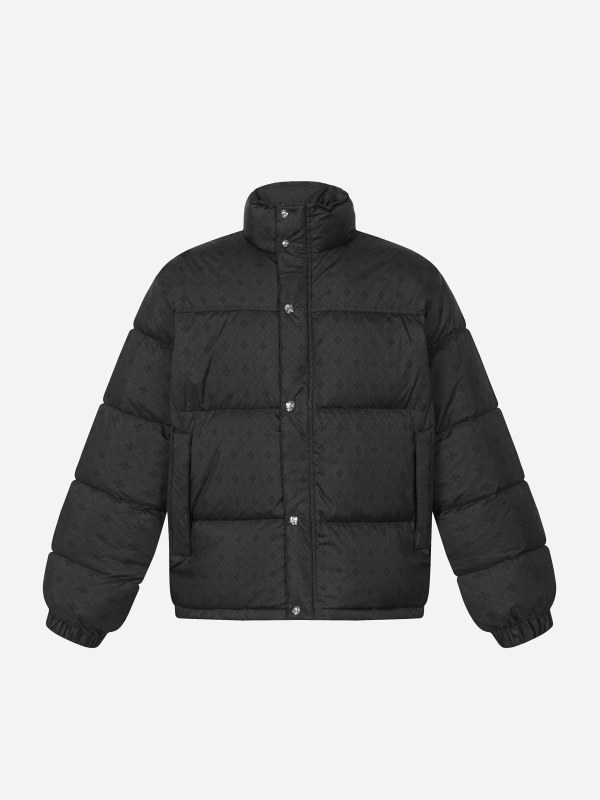
The warehouse images were honest about the silhouette. Quilted volume, the high stand collar, the snap placket and the elastic cuffs all matched. Ground colour matched too — a flat, matte black rather than the inky sheen that puffer photography often implies.
What QC cannot show is the jacquard. In the warehouse shots the shell reads as plain black. In raking daylight, the tonal weave surfaces as a low-contrast repeat across the chest and sleeves — visible at arm's length, invisible in a phone snapshot taken flat-on. That is not a defect; it is the point of the fabric. It does mean the jacket is quieter in person than a listing thumbnail suggests, and it will read as a plain black puffer to anyone more than two metres away.
Flat measurements, taken on a size-set mannequin
No measurement chart is published for this jacket, so we built one. Each figure is a single flat measurement in centimetres, taken with the garment settled and the baffles relaxed, not stretched. Across measurements are doubled for the chest circumference below.
| Measurement | Size M | Size L |
|---|---|---|
| Pit-to-pit (flat) | 59.0 | 61.5 |
| Chest circumference (doubled) | 118.0 | 123.0 |
| Back length, collar seam to hem | 69.5 | 72.0 |
| Shoulder, seam to seam | 50.0 | 52.0 |
| Sleeve, shoulder seam to cuff | 64.0 | 65.5 |
| Parcel weight (calibrated scale) | 1.29 kg | 1.34 kg |
The step between M and L is small — 2.5 cm across the chest, 2.5 cm in length — so the ladder behaves more like a half-size progression than a full one. Testers who normally sit between sizes found the M wearable over a mid-weight hoodie and the L genuinely roomy, not merely larger. Below 5 °C with a heavy knit underneath, the L did the work; the M pulled slightly across the upper back when both arms reached forward.
Snaps, collar and the draft question
The placket uses snap closures rather than a zip, which is the detail we expected to be the weak point. It was not. Snap centres aligned within 2 mm on both samples, and the placket flap sits flat when closed rather than rippling between fasteners — a common failure on budget puffer copies. The stand collar is tall enough to cover the chin without a scarf and stays up on its own when folded, which makes the difference on a windy morning.
Two editors wore it for a 4 °C walk with a light breeze. With the collar up and the hem cinched, the body stayed warm and the chest did not go cold at the placket line. The cuffs are elasticated and windproof in the way the listing claims; they seal over a glove cuff without pinching.
Fill, re-loft and what two weeks of wear showed
The filling is described as evenly distributed down, and after unpacking we gave both jackets 24 hours to recover from compression. Loft returned to near-full across the chest and back panels; the sleeves stayed slightly flatter, which is normal for a sleeve baffle and visible in our photographs.
Over a two-week wear log, no down migrated into the lower corners of the baffles and no quills worked through the shell. Quilting stitches were even, with no skipped or doubled lines, and seam allowance inside the collar matched on both samples. Tonal thread was used throughout, including at the pocket edges, so the hardware and stitching disappear into the black rather than outlining it.
Where the evidence stops
Three things we could not confirm and would not guess at. First, fill power: the listing says uniform down without a fill-power figure or a down-to-feather ratio, so the warmth claim is a description, not a graded specification. Second, water resistance: we saw drizzle bead and roll off the shell, but we did not run a sustained soak, so treat "water-resistant and stain-resistant" as stated intent rather than tested performance. Third, longevity: two weeks does not tell you what a shell does across a full winter of abrasion, and there is no independent buyer feedback on this exact jacket to lean on. The product-line editorial describing Chrome Hearts puffers as premium outerwear comes from a resale marketplace, not from testing this item.
How to order it without guessing
- Ask your agent for the flat pit-to-pit and back-length figures in your size, and compare them with the table above rather than with your usual letter size.
- Request a close-up of the shell under angled light so the jacquard is visible before the parcel ships.
- Ask for the stated fill composition in writing, plus photos of the hem adjuster and zipper and snap pulls.
- If you layer heavily, size up: the M-to-L gap is 2.5 cm, not a full size step.
At $149.25 (down from a listed $160.65) in S through XL and in stock at the time of writing, the jacket delivers the two details that are hardest to fake at this price — a snap placket that closes flat and a tonal weave with real depth. The gap is documentation, not construction.
Sources and notes
- How we tested
- We ordered sizes M and L through Kakobuy, compared warehouse QC photos against the parcel under daylight with a colour card, taped flat measurements on a size-set mannequin and two testers, photographed seams and hardware at 1:1, and ran a two-week wear log including a 4 °C walk.
- Catalog product page
Product listing verified on 2026-10-22.
2
Yes, but only at close range and in angled daylight. Flat-on and in phone photos the shell reads as plain black; the tonal weave appears across the chest and sleeves within about two metres.
3
Our samples stepped only 2.5 cm between M and L. A mid-weight hoodie fit under the M; heavier knitwear needed the L. If you sit between sizes and layer often, take the larger one.
4
The listing describes uniform down fill but gives no fill power or down-to-feather ratio. Our testers were comfortable on a 4 °C walk with a light knit; below that, ask your agent for the fill specification.
What works
- Snap placket aligns within 2 mm and sits flat when closed
- Tonal jacquard gives real depth in daylight, not in flat photos
- Loft recovered after compression; no quill leakage in two weeks
Watch-outs
- No published measurements or fill-power specification
- M-to-L step is only 2.5 cm, so layering room is limited
- Water resistance unverified beyond light drizzle
Buyers who want a matte black puffer with subtle texture, a stand collar that stays up, and are comfortable having an agent confirm measurements first.
Anyone who needs graded warmth figures, published sizing, or independent buyer reviews before spending, or who wants a brand-authorized return path.
Editor verdict
A tonal-jacquard puffer with a flat-closing snap placket and solid loft, held back only by the listing's silence on fill power and measurements.