Checking Oakley Links & QC: Spreadsheet vs Google Sheets
Insight
Jonas Reinhardt This article addresses a specific documentation task: when you want to organize product links, color information, and QC clues for Oakley [sunglasses](https://fashion-reps.net/accessories/sunglasses), how to first check the fashion-reps website-type Spreadsheet, then organize confirmed inf
Jonas Reinhardt is Editor-in-Chief of the Kakobuy Yupoo Review Desk, writing agent comparison tables and leading retests. The work covers shopping-agent operations, parcel forwarding and QC photo standards, with Jonas signing off every hands-on score. Reviews are checked for order dates, QC photo notes, warehouse measurements and shipping-line timings, connecting the comparison tables with the records behind their scores. Each month, two reviews are selected at random and audited against original photographs and receipts, making publication approval and recurring checks of the supporting material part of the editorial work.

This article addresses a specific documentation task: when you want to organize product links, color information, and QC clues for Oakley sunglasses, how to first check the fashion-reps website-type Spreadsheet, then organize confirmed information into Google Sheets, avoiding treating unverified products, images, or links as a basis for purchase.
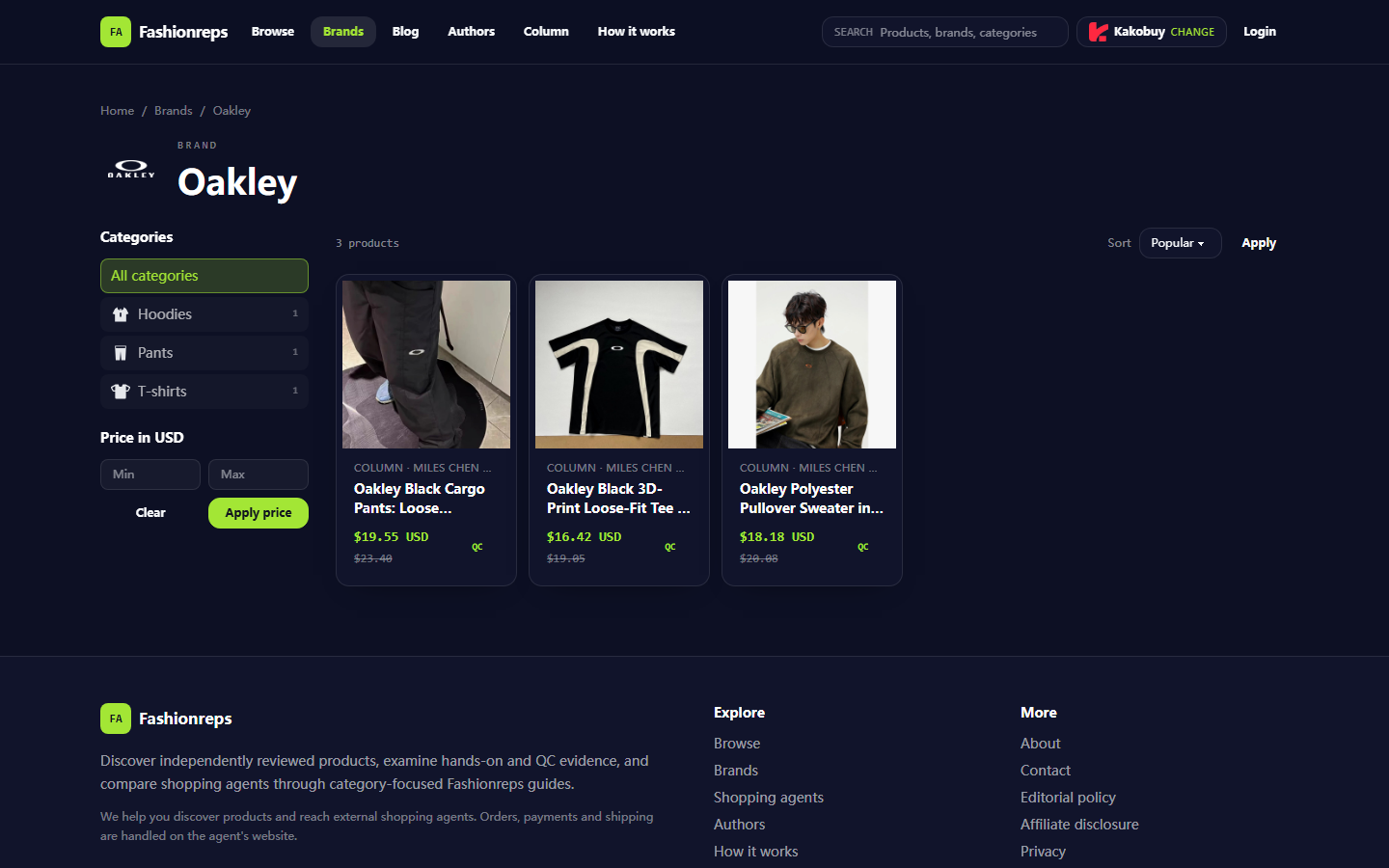
Verification boundary is as of October 13, 2026. The currently provided Oakley brand page shows 3 products: black cargo pants, black 3D-printed loose short-sleeve shirt, and polyester pullover; there are no confirmed Oakley sunglasses items in the page screenshot. Therefore, this article will not rewrite clothing items as sunglasses, nor fabricate sunglasses links, stock, colors, prices, or QC images. 🕶️
The record-keeping task and evidence boundary
Your goal is not simply collecting a list of URLs, but establishing a re-checkable evidence chain:
- First, confirm whether the target product actually appears in the website-type Spreadsheet.
- Then record the name, category, reference price, and link entry shown on the product card.
- Record color, style, and QC clues separately; do not infer color from the product name, nor infer texture or authenticity from product images.
- Place verified content into Google Sheets, retaining verification date and status.
- Before ordering, reopen the link to confirm the page still exists and the information has not changed significantly.
The page evidence can only support the following judgment: Fashionreps provides brand browsing, product cards, category filtering, price filtering, sorting, and shopping agent selection entry points; the currently visible results on the Oakley brand page are not sunglasses. The page also explicitly states that purchase, payment, and logistics are handled by external shopping agent websites. Therefore, the product discovery function of the website-type Spreadsheet cannot replace the order, stock, payment, or shipping status on the agent platform. 🔎
How to locate Oakley sunglasses in the fashionreps website-type Spreadsheet
First enter the Oakley page from the brand entry, then observe the actual product categories and product cards displayed on the page. Do not judge results solely based on the page title, as brand pages may include clothing, accessories, or other categories.
Recommended order of operations:
- Enter the Oakley brand page and confirm that both the page path and brand name correspond to Oakley.
- Check the current total number of products and categories. The provided page screenshot shows 3 items, and the category filter includes Hoodies, Pants, and T-shirts, with no Sunglasses category displayed.
- Use the in-page search, category, price, and sorting functions to continue checking, but do not interpret filtered empty results as "product out of stock" or "the site does not have this category"; also confirm whether the filter criteria are too narrow.
- Open each relevant product card and record the product name, reference price, and visible image actually shown on the page.
- If there are no sunglasses product cards, mark the result as "not found in this verification page" instead of creating a speculative link.
- Before selecting a shopping agent, save evidence of the product page. The page shows that multiple external agents can be selected, but selecting an agent does not mean the product is in stock, nor that the agent has accepted the order.
The 3 Oakley items currently shown on the page can serve as samples for verifying page functionality, but cannot be recorded as Oakley sunglasses. The following fields are only used to distinguish between "actual page content" and "target to be verified."
| Record object | Current visible information on page | Significance for sunglasses record |
|---|---|---|
| Oakley brand page | Shows 3 items, categories Hoodies, Pants, T-shirts | Can confirm brand navigation and filtering structure, but cannot confirm existence of sunglasses |
| Product card | Shows product name and reference price | Can record items that appear, cannot infer prices for sunglasses that do not appear |
| QC entry or clue | Page navigation has QC-related entry, but this screenshot does not provide specific QC images for any particular sunglasses | Need to open each product and verify, cannot treat a generic entry as evidence for a single item |
| Shopping agent selection | Page allows selecting external shopping agents | Only indicates purchase path entry, does not indicate stock, payment, or logistics confirmed |
How to set up link, color, and QC clue columns in Google Sheets
The value of Google Sheets is turning scattered verification results into filterable, collaborative, and trackable records. It should not replace the original product page, but should save a summary of the original page and re-check status.
Recommended columns:
- Product name: Copy the full visible name from the product page.
- Target category: e.g., sunglasses, hoodie, pants, or to be confirmed.
- Page URL: Save the product page address; do not use the brand page address as a substitute for the single item address.
- Brand page URL: For returning to the Oakley brand catalog for re-checking.
- Color original text: Only fill in the color explicitly stated on the product page; if no clear color, fill in "not specified."
- Style or model: Only record the model, style term, or specification actually shown on the page.
- Reference price: Keep the page currency and verification date; do not treat reference price as final cost.
- QC clue: Record whether there is single-item QC image, QC page, or verifiable material uploaded by external users.
- QC evidence status: Can use "seen single item image," "only entry seen," "not found," "to be re-checked."
- Link status: Can use "accessible," "redirect," "blank page," "404," "to be re-checked."
- Verification date: Fill in the date of the most recent actual page opening.
- Notes: Record issues such as category mismatch, missing information, insufficient images, or agent process pending confirmation.
The color column especially requires restraint. When the product name does not state a color, do not fill in "black" or "silver" based on thumbnail color; images may be affected by lighting, compression, or page display. If color is a critical field for purchase decision, confirm again on the product detail page or agent order page. 🎨
In Google Sheets, you can use filter views to view separately:
- Records with target category sunglasses.
- Records with link status not "accessible."
- Records with QC evidence status "not found" or "to be re-checked."
- Records with earlier verification date that need to be reopened.
- Records with confirmed page but not yet verified shopping agent path.
Do not use color fill as a substitute for text status. Green can help browsing, but text like "accessible" and "seen single item image" is the auditable information.
How to compare product card and spreadsheet row information item by item
Each new row record should be confirmed item by item by returning from the product card to the original page. Recommended one-way process: page evidence collection, spreadsheet entry, reopen verification, rather than batch guessing content in the spreadsheet first.
Key items to check during comparison:
- Does the product name match exactly? Do not confuse brand page title, product card title, and agent platform title.
- Does the product category match? The currently visible results on the Oakley brand page belong to clothing categories; cannot enter them into the sunglasses sheet just because the brand is the same.
- Is the price still visible? The reference price on the page may change and may not include agent service fees, international shipping, taxes, or other fees.
- Does the image belong to the product? List thumbnail, detail image, and QC image serve different purposes and cannot replace each other.
- Can the page still be accessed? Opening the brand page does not mean the single item link is valid.
- Does the product name include color or model? If no clear field, mark "not specified" in the spreadsheet.
Comparison results can be divided into three statuses:
- Confirmed: product page accessible, name and category match, key fields from visible page information.
- Partially confirmed: page accessible, but color, model, QC image, or price missing.
- Excluded: page does not match target category, link invalid, content empty, or cannot support subsequent judgment.
The visible clothing items on this Oakley page should be classified as "partially confirmed" or "target category mismatch," not added to the Oakley sunglasses candidate list. This reduces the number of rows but avoids later sending the wrong product to a shopping agent. ✅
How to record QC image entry and visible evidence separately
QC clues should be separated into at least three layers: entry, image, and judgment.
Entry means the page or shopping agent provides QC-related navigation. It only indicates that there is a path to find QC information. Image refers to a viewable image corresponding to a specific product or order. Judgment is a description of what is visible in the image, such as whether the lens color matches the page description, whether the temple logo is visible, or whether there is obvious shipping damage.
When there is no specific image, only write "QC image not provided" or "only QC entry seen." Do not write "good workmanship," "clear logo," "consistent with authentic," or "QC passed." These conclusions require corresponding visible evidence, and authenticity cannot be proven by a single image.
If QC images are obtained later, add to the spreadsheet:
- Image source.
- Corresponding product or order identifier.
- Image verification date.
- Whether name, phone, address, order number, and payment information are masked.
- Visible facts.
- Items that cannot be determined.
QC images only help record visible condition; they cannot guarantee authenticity, long-term durability, or final wearing effect. For sunglasses, lens specifications, UV protection claims, dimensions, and destination country compliance requirements should also be independent verification items. 🛡️
How to mark broken links, information gaps, and update time
"To be re-checked" in the spreadsheet should not become a permanent status. It is recommended to set a next action for each record, such as reopening the product page, returning to the brand page to check categories, asking the agent if the item can still be purchased, or removing candidate records that are no longer applicable.
Recommended marking methods:
- Accessible: page opens, and has clear product name and sufficient visible information.
- Accessible but insufficient: page exists, but missing color, specification, image, or QC clue.
- Redirect: link jumps to another page, need to confirm if still the same product.
- Blank page: page opens, but not enough product content.
- 404: page does not exist.
- Category mismatch: page exists, but is not the target sunglasses product.
- To be re-checked: beyond set period, or page has recently changed.
Update time should match the type of fact. Price, stock, agent purchasability, shipping, taxes, and link status may change rapidly; brand name and spreadsheet field structure are usually more stable. Before publishing or ordering, re-check highly volatile fields and record destination country, currency, and verification date.
Do not write "the page currently has no sunglasses" as "Fashionreps never has sunglasses." More accurate record: "As of October 13, 2026, no sunglasses product cards were seen on the Oakley brand page in this verification."
Applicable scenarios for website-type Spreadsheet, Google Sheets, and combined workflow
Website-type Spreadsheet is more suitable for discovering products and browsing context: users can browse by brand, category, price, or sorting, view product cards, and enter shopping agent selection from the page. Its advantage depends on the actual content provided by the page and cannot be extended to unverified stock, speed, or QC conclusions.
Google Sheets is more suitable for organizing discovered records: users can create fields, filter status, add verification dates, assign re-check tasks, and allow multiple people to collaboratively maintain the same list. It does not verify links by itself, nor automatically prove that an image belongs to a product.
The combined workflow can be arranged as follows:
- Confirm whether the target product actually appears on the fashionreps Oakley brand page.
- Open the product card and save the single item page and visible fields.
- Enter fact fields into Google Sheets, clearly marking missing content.
- Re-check links, colors, prices, and QC entries separately.
- Reopen the single item page and shopping agent page before preparing to order.
- Only pass records with matching category, valid link, and key facts verified to the next purchase step.
For this task, the most important conclusion is: the website-type Spreadsheet can help you check the Oakley brand catalog, but the current page evidence provided is insufficient to establish Oakley sunglasses candidate records. Google Sheets should retain this "target product not found" result, rather than filling the spreadsheet with blanks or guesses. 📋
Pre-order re-check checklist and next steps
Complete at least the following checks before ordering:
- The product is indeed sunglasses, not Oakley clothing or other accessories.
- Product name, single item page, and brand page correspond to each other.
- Color, model, size, and lens information come from explicit page content, not inferred from thumbnails.
- Product link is currently accessible and does not redirect to blank or irrelevant pages.
- QC clue corresponds to a specific product; if only a generic entry, clearly write "only entry seen."
- Reference price is marked with currency and verification date, not mistaken for final cost.
- Shopping agent, payment, international shipping, taxes, customs, and after-sales terms are independently confirmed on the corresponding agent page.
- Google Sheets retains link status, evidence status, and next action.
- Order, address, phone, payment information, and complete shipping label are not made public in shared spreadsheets or screenshots.
This record-keeping method saves not a fixed amount, but reduces repeated searches, wrong orders, and follow-up communication costs caused by incorrect category, broken links, or unverified QC clues. The added work is opening pages one by one, maintaining status, and regular re-checking. It is suitable for people who need multi-person collaboration, want to keep an evidence chain, or manage multiple candidate products simultaneously; it is not suitable for those who only want to order quickly based on brand name and are unwilling to verify single item pages and agent conditions.
For the current Oakley page, the next step is to wait for or find a product page that actually shows sunglasses, then add that single item to Google Sheets. Without single item evidence, the safest status remains "target product not found in this page verification," rather than filling in speculative links.