Organizing Represent Candidates: Spreadsheet vs Sheets
Insight
Jonas Reinhardt## The Represent Candidate Organization Task This Article Solves If you're organizing [Represent](https://fashion-reps.net/brand/represent) candidates, the real problem isn't "where to see more products," but how to turn visual discoveries, product links, and page information from a website catalog into a candidate list that can be filtered, reviewed, and used collaboratively. This article uses the Represent product catalog visible on fashion-reps.net as the object, explaining the division of la
Jonas Reinhardt is Editor-in-Chief of the Kakobuy Yupoo Review Desk, writing agent comparison tables and leading retests. The work covers shopping-agent operations, parcel forwarding and QC photo standards, with Jonas signing off every hands-on score. Reviews are checked for order dates, QC photo notes, warehouse measurements and shipping-line timings, connecting the comparison tables with the records behind their scores. Each month, two reviews are selected at random and audited against original photographs and receipts, making publication approval and recurring checks of the supporting material part of the editorial work.
The Represent Candidate Organization Task This Article Solves
If you're organizing Represent candidates, the real problem isn't "where to see more products," but how to turn visual discoveries, product links, and page information from a website catalog into a candidate list that can be filtered, reviewed, and used collaboratively.
This article uses the Represent product catalog visible on fashion-reps.net as the object, explaining the division of labor between a website-style spreadsheet and Google Sheets. The website is good for discovering and browsing candidates, while Google Sheets is good for establishing unified fields, comparing styles, recording verification results, and arranging follow-up actions.
One thing needs to be clarified first: pandabuy ceased normal operations after April 11, 2024, so this article does not treat pandabuy as a currently executable purchasing channel. Candidate discovery, link recording, and data organization on the page should be handled separately from actually available purchasing agent platforms. 🧭

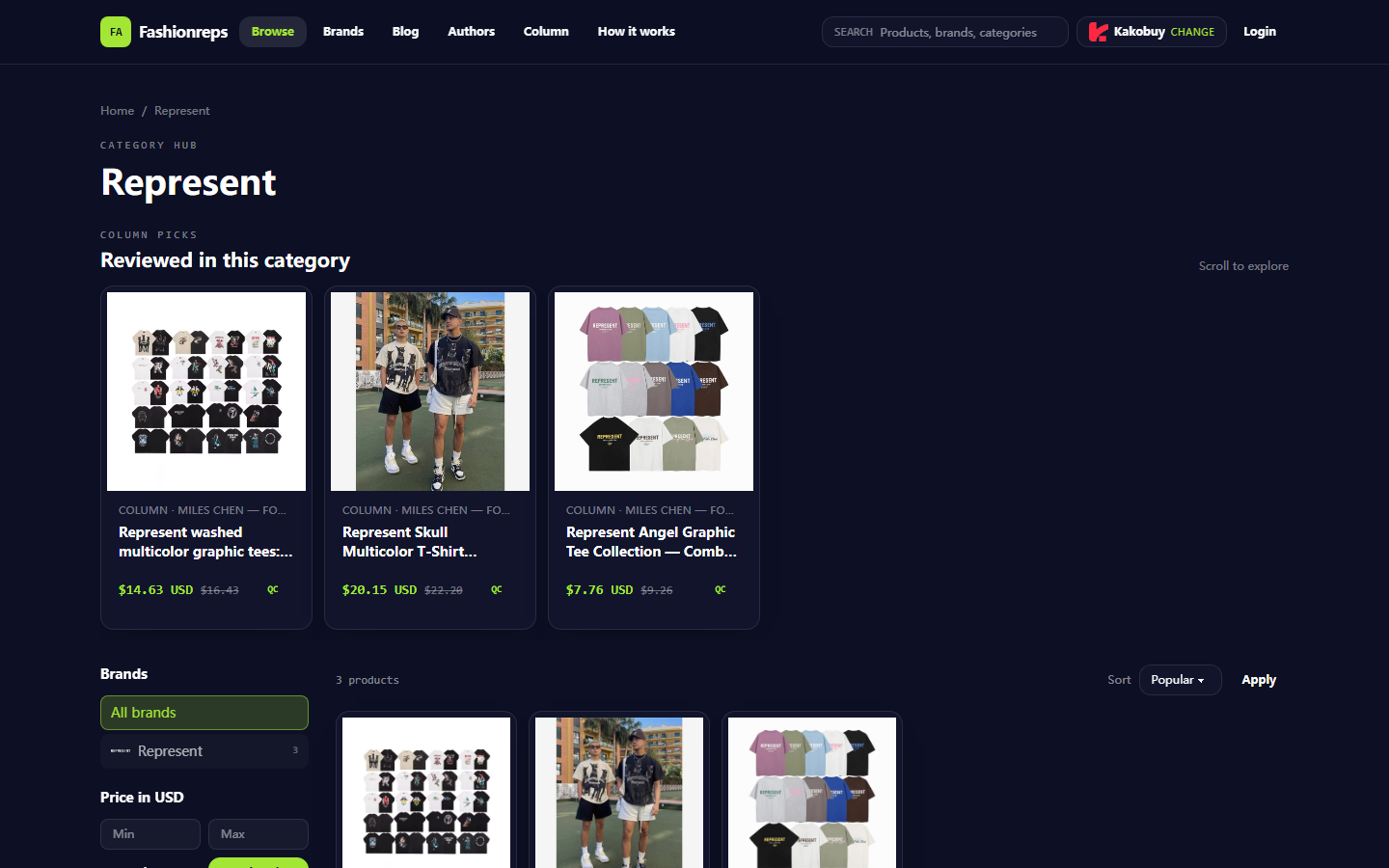
Image: The Represent catalog page and candidate discovery interface on fashion-reps.net. Page functionality and visible product information are subject to the page at the time of verification.
How to Enter Brands and Categories in the pandabuy Website-Style Spreadsheet
In the visible catalog on fashion-reps.net, Represent serves as a brand category entry. The page first provides brand aggregation and product cards, then leads to specific candidates. The currently verified page shows 3 Represent product candidates and offers price filtering, sorting, and product card browsing.
The typical browsing path on the page is:
- Enter the brand or category entry.
- View the title, reference price, and QC mark in the product card.
- Filter candidates by price range.
- Sort by Popular, Latest, Price: low to high, or Price: high to low.
- Open the specific product page to continue checking images, specifications, and purchase links.
This website-style catalog is more suitable for first-round discovery, because candidates are presented as image cards with brief descriptions, allowing users to quickly judge pattern, silhouette, and color direction. Its focus is on reducing search cost, not building a complete procurement ledger for you.
The Represent candidates displayed on the current page include:
- Washed multicolor graphic tees, described on the page as combed cotton, relaxed cut, and heat-transfer prints, with a reference price of $14.63; the page also shows a previous reference price of $16.43.
- Skull Multicolor T-Shirt Collection, described on the page as oversized, 230 gsm cotton graphics, with a reference price of $20.15; the page also shows a previous reference price of $22.20.
- Angel Graphic Tee Collection, described on the page as combed cotton crew necks and multiple colorways, with a reference price of $7.76; the page also shows a previous reference price of $9.26.
These prices are reference information visible on the page and do not equal current inventory, final product price, international shipping, taxes, or agent service fees. Prices, link status, and product availability should be re-verified before actually preparing to order, and the verification date should be recorded in the table. 📅
What Style, Color, Size, and Link Fields Should Be Established in Google Sheets
The value of Google Sheets lies in breaking down information from different product cards into unified fields. Don't just copy titles, otherwise you won't be able to compare different colors, sizes, or link statuses of the same style later.
It's recommended to establish at least the following fields:
| Field | Purpose | Suggestion for Filling In |
|---|---|---|
| Candidate ID | Allows the team to quickly reference a row | Use a fixed ID, such as REP-001 |
| Brand | Facilitates cross-brand filtering | Fill in Represent |
| Product Title | Preserve the original page title | Don't rewrite it into a confirmed product name without authorization |
| Style Tag | Facilitates comparing patterns and silhouettes | E.g., graphic tee, skull, angel, washed, oversized |
| Color | Distinguishes colorways and pattern versions | Fill in "to be verified" if not specified on the page |
| Size | Records visible size information | Don't speculate on body fit if there's no size chart |
| Weight or Material | Preserves specifications provided by the page | E.g., 230 gsm; leave blank if missing |
| Product Page URL | Returns to the original candidate page | Check each time whether it is still accessible |
| Reference Price | For preliminary comparison | Also record the currency and verification date |
| Image Status | Determines whether additional evidence is needed | E.g., "has catalog image", "awaiting QC image" |
| Link Status | Controls subsequent review | Valid, redirect, not opening, to be verified |
| Next Step | Clarifies action | Check size, view QC, ask about stock, or exclude |
You don't need to expand the table to dozens of columns at once. The goal of the first round of organization is to enable each candidate to answer four questions: what it is, why it was selected, where to review it, and what to do next. 🗂️
If you need to compare colors and sizes, it's recommended to record only one specific variant per row. When a product page has black, gray, and different sizes, you can use the same product ID and add a variant ID. This way, when filtering for "gray, size L, to be verified" records, multiple variants won't be mixed in one row.
How the Same Candidate Corresponds Between Website Cards and Table Rows
Website cards are discovery units, while Google Sheets rows are management units. The two cannot be simply understood as one card always corresponding to one row, because a product page may contain multiple colors, sizes, or pattern versions.
It's recommended to use the following correspondence:
- Catalog cards correspond to a "product-level ID."
- Specific colors, sizes, or variants correspond to separate "variant-level IDs."
- Keep the original page text for product titles, and fill in style tags separately.
- Save the product page URL directly; don't just save the search results page or brand homepage.
- If two cards look similar, first compare product page URLs, images, specifications, and descriptions before deciding whether to merge.
- If the URLs are the same but page descriptions differ, keep the difference and mark "needs review"; don't directly overwrite old records.
For example, REP-001 can represent a pattern T-shirt product page, while REP-001-BK-L represents the black size L variant of that product. This numbering method allows multiple people to accurately refer to a specific candidate during discussion and avoids adding the same link repeatedly.
Division of Labor for Image Preview, Keyword Search, and Filters
Website catalogs and Google Sheets have different search methods, so it's best to split tasks.
Website catalogs are better for:
- Quickly identifying patterns, wash effects, and overall silhouettes through images.
- Browsing similar candidates by brand or category.
- Using existing price filters to narrow down.
- Viewing product cards by popularity, latest, or price order.
- Opening product detail pages to continue viewing page-visible information.
Google Sheets is better for:
- Combined filtering by color, size, weight, price, and verification status.
- Searching for product links that have already appeared to reduce duplicate organization.
- Adding exclusion reasons to candidates, such as missing size chart, broken link, or insufficient information.
- Assigning review tasks to different members.
- Recording update times, verification dates, and next steps.
Don't write visual impressions from website cards directly as verified facts. For example, an image that looks like thick fabric doesn't confirm material or weight; a title that says cotton doesn't mean all colorways and sizes have the same specifications. Visual judgment can be used as "notes to be verified," but cannot replace product page information. 🔍
Verification Boundaries for Product Links, Specifications, and Update Times
After completing the candidate organization, at least one row-by-row review should be done. The review is not to prove that a product is definitely worth buying, but to confirm that records in the table do not exceed the scope of page evidence.
It's recommended to check in the following order:
- Whether the product page is still accessible.
- Whether the page displays a clear product name, not a blank page, tab page, or invalid redirect.
- Whether the currency and display date of the reference price are recorded.
- Whether the page provides color, size, material, or weight information.
- Whether the catalog image matches the product page content.
- Whether the page provides QC or other materials for further judgment.
- Whether the product link belongs to an external purchasing process that is still currently usable.
- Whether the "valid," "to be verified," or "invalid" status in the table is consistent with this check.
For prices, inventory, shipping, taxes, returns, and purchasing channels, don't infer current status from old records. They may change over time, region, product variant, or agent platform. You can set up "last verification date" and "verifier" columns in the table so that old information isn't mistaken for the latest.
The fashion-reps page states that its role is to help users discover products, view independently organized product information, and jump to external shopping agent platforms; orders, payment, and international shipping are handled by the agent platform. Therefore, after completing the Represent candidate list, you still need to re-confirm product links, purchasable status, domestic shipping, inspection arrangements, and international logistics conditions on the agent platform you actually use.
Scenarios Suitable for Quick Discovery, In-Depth Organization, and Multi-Person Collaboration
If the task is to quickly find Represent patterns worth further review, the website catalog is more suitable. It puts brand, images, brief descriptions, and price filters in the same browsing path, suitable for initially forming a small candidate set.
If the task is to compare multiple colors, sizes, or different patterns, Google Sheets is more suitable. It can convert scattered information from the website into unified rows and columns, and use filters to find records that are "below a certain reference price," "missing size information," or "not verified for a certain period."
If the task involves multi-person collaboration, it's recommended that one person be responsible for website discovery, another for specification and link review, and finally a lead person uniformly handles duplicate candidates. Each person only modifies the fields they are responsible for, to avoid overwriting product titles, prices, and verification statuses simultaneously.
The reasonable division of labor between the two tools can be summarized as: the website is responsible for discovery and browsing, Google Sheets for structuring and tracking, and the actual purchasing agent platform for ordering, warehouse inspection, parcel consolidation, international shipping, and after-sales. Don't mistake website catalog or table records for order status. ✅
Review and Next Steps After Completing the Represent Candidate List
After completing the first version of the list, you can first delete completely duplicate links, then keep candidates with insufficient information but still research value. Don't delete all "to be verified" records just to make the table look neat. It's better to keep a clear next step, such as "add size chart," "confirm whether color is selectable," or "check if product page is restored."
It's recommended to ultimately organize into three categories:
- Can continue verification: product page accessible, and sufficient information to support next step.
- Deferred: page accessible, but missing size, color, specifications, or current link status.
- Excluded: link invalid, duplicate content, insufficient information to support judgment, or does not meet current filter conditions.
If you plan to purchase later, don't choose candidates based only on reference price. You should put product price, domestic shipping fees, agent service fees, international shipping, possible taxes, inspection needs, and return restrictions in the same decision. Consolidating parcels may reduce repeated first-weight or some operational costs, but may increase parcel value, volumetric weight, and single-loss risk; splitting parcels may increase fixed costs, but may adapt to route restrictions or reduce single-parcel risk. Specific judgment must be calculated based on actual product weight, destination country, route, and fee samples.
This organization method is most suitable for users who need to repeatedly compare Represent candidates, keep review records, or jointly maintain a list with others. It's not recommended to rely only on website cards to complete purchases, nor to treat unverified prices, inventory, sizes, or logistics information as current facts. The next step can start with 3 candidates, fill in links, variants, specifications, and verification dates row by row, and then decide which records enter the actual purchasing process.
Common Questions About Shopping on Agent Platforms
1. What product categories can be browsed in pandabuy's spreadsheet?
Pandabuy's spreadsheet lists shoes, clothing, handbags, accessories, sweatshirts, perfumes, hats, scarves, belts, and various household items.
2. What should first-time users of agent platforms like pandabuy pay attention to?
First-time pandabuy users accessing Taobao agents through spreadsheets generally receive a new member shipping discount coupon and need to read the step-by-step beginner shopping tutorial.